Nothing we really didn't already know, but it's certainly intriguing technology...
Scientists, Archeologists Say Infrared Tool Led Them To Last Supper Room
Showing posts with label The Cenacle Scroll. Show all posts
Showing posts with label The Cenacle Scroll. Show all posts
Saturday, May 23, 2020


Saturday, December 02, 2017
Judge, meet book cover...
I think this new cover for The Cenacle Scroll does a much better job of telegraphing the mystery and intrigue of the story than does my original, ham-handed cut-and-paste job.

Thursday, July 16, 2015
Literary Comfort Food for a Fed Up Citizenry ...
How to sell books. That's the question, isn't it, at least for those of us who've chosen to commit stories to print in the hope that another will pay for the pleasure of reading them.
I've always marched to the beat of my own drummer when it came to the stories that I've chosen to tell. I've written two pretty straightforward novels of libertarian political suspense (The Third Revolution and Middle America), a soft sci-fi/adventure about a young girl and her runaway pets (Little Birdies!), a sort of speculative political thriller about a new alcohol prohibition and a group of neighborhood friends who decide to go another way on the matter (The Last Bartender), a soft sci-fi, archaeologically-themed action/suspense/political farce (The Cenacle Scroll) involving the political and religious chaos that follows the unexpected appearance of the (assumed) Holy Grail in the US, and a soft sci-fi mystery/adventure (Aqua Vitae) about a wildlife biologist who accepts a too-good-to-be-true job and ends up having to unpack several puzzling ecological mysteries before finding herself targeted by the government agency whose failed experiments have gone native.
This eclectic portfolio has been, as you might guess, marketing suicide. You don't need an MBA to see that the smart move here would be to pick a lane (i.e. a literary genre), and stick to it. Become the political thriller guy, the sci-fi/adventure guy, the dystopian future guy, the detective/crime procedural guy, the medical mystery guy, the vampire/zombie/time travel guy. Pick a lane!
Targeted advertising is easier if you pick a lane. Building a unified reader base is easier if you pick a lane. Finding a traditional agent/publisher is easier if you pick a lane. Using an outside marketing service is easier if you just pick a damn lane!
The truth is that I have picked my lane, though I've chosen to go with theme, rather than the more easily marketed concept of genre. If I may:
Ben Kane finds that he bit off more than he could chew when he takes over the Governor's office in Montana, and finds himself arrayed against the might of the US federal government, but is simply unable to back away from his principles.
Young Mandy Grant finds it impossible to accept the death sentence demanded by a nervous public and their government representatives for her runaway pets, and plots their rescue.
In the aftermath of a newly imposed prohibition on the production and sale of alcohol,
Justin Gardiner and his friends just want a damn beer, and they're prepared to do what they have to do to get one.
Graduate student Jennifer Goodwyn makes one ill-considered decision regarding an ancient relic and finds herself swept up in a religious and political maelstrom of her own making. It needs to be fixed, and she needs to do so without getting caught, and without anyone else getting hurt in the process.
After a string of career setbacks, wildlife biologist Jackie Bannon takes a leap of faith, unintentionally stirs up a mystery that was better left untouched, and needs to extract herself and her friends from a sudden and dangerous game of "kill the messenger."
All of my protagonists want the usual things out of life, and take seemingly rational steps to reach those goals, modest or otherwise. Other people, more organized people (say, local, state or federal government agencies, for example) sometimes take exception to individual needs, wants or circumstances, and do what they can to thwart individual action. Some individuals (say, the ones I choose to write about) feel they have no choice but to follow their conscience and do what they have to do to get where they need to get, regardless of the forces brought against them.
So if you don't mind veering out of your literary comfort zone just a bit, I believe you'll find that at the heart, my stories have what you're looking for: regular people, who for whatever reason, suddenly find themselves up against it and, along a few close friends, choose principle over authority.
As always, thanks for your support...
I've always marched to the beat of my own drummer when it came to the stories that I've chosen to tell. I've written two pretty straightforward novels of libertarian political suspense (The Third Revolution and Middle America), a soft sci-fi/adventure about a young girl and her runaway pets (Little Birdies!), a sort of speculative political thriller about a new alcohol prohibition and a group of neighborhood friends who decide to go another way on the matter (The Last Bartender), a soft sci-fi, archaeologically-themed action/suspense/political farce (The Cenacle Scroll) involving the political and religious chaos that follows the unexpected appearance of the (assumed) Holy Grail in the US, and a soft sci-fi mystery/adventure (Aqua Vitae) about a wildlife biologist who accepts a too-good-to-be-true job and ends up having to unpack several puzzling ecological mysteries before finding herself targeted by the government agency whose failed experiments have gone native.
This eclectic portfolio has been, as you might guess, marketing suicide. You don't need an MBA to see that the smart move here would be to pick a lane (i.e. a literary genre), and stick to it. Become the political thriller guy, the sci-fi/adventure guy, the dystopian future guy, the detective/crime procedural guy, the medical mystery guy, the vampire/zombie/time travel guy. Pick a lane!
Targeted advertising is easier if you pick a lane. Building a unified reader base is easier if you pick a lane. Finding a traditional agent/publisher is easier if you pick a lane. Using an outside marketing service is easier if you just pick a damn lane!
The truth is that I have picked my lane, though I've chosen to go with theme, rather than the more easily marketed concept of genre. If I may:
Ben Kane finds that he bit off more than he could chew when he takes over the Governor's office in Montana, and finds himself arrayed against the might of the US federal government, but is simply unable to back away from his principles.
Young Mandy Grant finds it impossible to accept the death sentence demanded by a nervous public and their government representatives for her runaway pets, and plots their rescue.
In the aftermath of a newly imposed prohibition on the production and sale of alcohol,
Justin Gardiner and his friends just want a damn beer, and they're prepared to do what they have to do to get one.
Graduate student Jennifer Goodwyn makes one ill-considered decision regarding an ancient relic and finds herself swept up in a religious and political maelstrom of her own making. It needs to be fixed, and she needs to do so without getting caught, and without anyone else getting hurt in the process.
After a string of career setbacks, wildlife biologist Jackie Bannon takes a leap of faith, unintentionally stirs up a mystery that was better left untouched, and needs to extract herself and her friends from a sudden and dangerous game of "kill the messenger."
All of my protagonists want the usual things out of life, and take seemingly rational steps to reach those goals, modest or otherwise. Other people, more organized people (say, local, state or federal government agencies, for example) sometimes take exception to individual needs, wants or circumstances, and do what they can to thwart individual action. Some individuals (say, the ones I choose to write about) feel they have no choice but to follow their conscience and do what they have to do to get where they need to get, regardless of the forces brought against them.
So if you don't mind veering out of your literary comfort zone just a bit, I believe you'll find that at the heart, my stories have what you're looking for: regular people, who for whatever reason, suddenly find themselves up against it and, along a few close friends, choose principle over authority.
As always, thanks for your support...
Thursday, May 09, 2013
Free Kindle Reading Apps...

I assume everyone is aware of these free applications, but it doesn't hurt to spread the word. All six of my books are available as Kindle ebooks, and there's no need to shell out the bucks for a Kindle device if you don't need to. I download and read Kindle books on my old Windows XP Dell laptop, and it works just fine. Reading apps are available for pretty much every imaginable device (smartphones, tablets, computers) and across a broad selection of operating systems.
You can download the apps here: Free Kindle Reading Apps. And please consider my reasonably priced and entertaining offerings to get your Kindle collection started: Books by Anthony F. Lewis.
Thursday, April 05, 2012
2,000 years later, and they're still fighting over the Cenacle...

"If there's one building in Jerusalem that represents the tangle of religions in this city, this is it. The ground floor is a Jewish holy site said to house the tomb of the biblical King David. The second floor is the Cenacle, a Christian holy site, the room believed to be the site of Jesus' Last Supper. On the roof, there's an old minaret from when this place was marked a Muslim holy site. One building, three religions, decades of property disputes. And the fight isn't over."
Read the entire article here: Vatican, Israel Spar Over Disputed Last Supper Site.
And if that's got your attention, wait until you see the fight that develops over the revelations of the Cenacle Scroll. Opening chapters here...
A little more on the story here: Holy Thursday: Agreement over the Cenacle?
Thursday, August 04, 2011
An Accurate History of the Cenacle (Site of the Last Supper)...
What's interesting about this recitation of the history of the Cenacle/David's Tomb is that rather then repeating the stories of legend and tradition, you're hearing an accurate rendition of the rather disputed and chaotic history of the location. The bottom line is that Jerusalem was destroyed in 70 A.D., and along with it any original structure that may have played host to the Last Supper. What you see now is essentially a tourist attraction that was build up over a series of memorial chapels starting around 300 A.D.
All of this history is reflected in the back-story of my novel, The Cenacle Scroll. Check out the opening chapters here.
From The Cenacle Scroll:
All of this history is reflected in the back-story of my novel, The Cenacle Scroll. Check out the opening chapters here.
From The Cenacle Scroll:
Udi was standing in the courtyard of the three-story, 12th-century building purporting to house both King David's Tomb and, on the second floor, the Cenacle, believed by Christians to be the site of the Last Supper. The truth was King David was no more entombed beneath the building than he was under Udi's front yard. But it had been venerated as such for almost a thousand years and there seemed little point in stopping now.
The reality was that the Crusaders had constructed the building as a chapel to the Last Supper over an already existing synagogue memorializing David's Tomb. The romanticized tourist literature aside, in the eyes of the scientific community that's all it was, just a very old memorial chapel with nary a stone, scrap of plaster or fragment of tile ever found and dated to the time of Christ.
Monday, March 28, 2011
In what order should I read your books?
I get this question once in a while and figured it was time that I got the official response on the record: except for the "Ben Kane" series (The Third Revolution and its sequel, Middle America), it doesn't matter. Little Birdies!, The Last Bartender and The Cenacle Scroll (ebook only) are stand-alone novels cast with their own unique characters and storylines and can be read in whatever order strikes your fancy. Summaries of all the books are conveniently located here: About the Books. I hope that helps...
Sunday, December 19, 2010
Hot Plate!
I never get tired of this stuff! Yet another intrepid Fiestaware collector with a Geiger counter. Watch and learn:
And another!
For more on this better-than-scifi phenomenon check here and here. To see why any of this matters, read The Cenacle Scroll...
And another!
For more on this better-than-scifi phenomenon check here and here. To see why any of this matters, read The Cenacle Scroll...
Sunday, October 17, 2010
Radioactive Fiestaware and the people who detect it...
After all of the research I did for The Cenacle Scroll, I'm not surprised that there's a lot of radioactive Fiestaware still being uncovered out there. What amazes me is how many people have Geiger Counters...
I've posted more on the subject here, and here. The Cenacle Scroll is non-radioactive (though honestly, I don't have a Geiger Counter, so who knows?), and is available as a Kindle e-book...
I've posted more on the subject here, and here. The Cenacle Scroll is non-radioactive (though honestly, I don't have a Geiger Counter, so who knows?), and is available as a Kindle e-book...
Wednesday, May 19, 2010
Another cool look at hot dinnerware....
A little while ago I posted a piece about radioactive dinnerware. In brief, red Fiestaware made from 1936 through 1943, and from 1959 through 1969, used Uranium as a coloring agent in the glaze. Watch this:
That's one way to keep the soup warm...
That's one way to keep the soup warm...
Monday, March 29, 2010
Your Radioactive Dinner Setting...
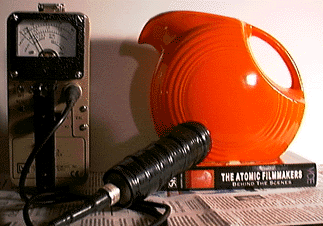
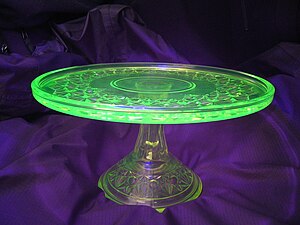
The use of Uranium in pottery glazes is central to a major plot twist in The Cenacle Scroll. The first example of such usage dates back to 79A.D., to a sample of green/yellow mosaic glass taken from a Roman villa near Naples, though that fact is in dispute. I managed to exploit that little-known factoid into a cause of considerable consternation for my protagonist and to the God-fearing public at large.
The short video clip below demonstrates how "hot" a single piece of red/orange Fiestaware can be:
If you're interested in seeing how a smattering of science can be twisted into an entertaining societal farce, please be sure to check out The Cenacle Scroll, available at Amazon as a Kindle e-book.
Monday, March 08, 2010
Does the world really need yet another Holy Grail story?

This isn't meant to be disrespectful in any way. Jesus and the Apostles were, after all, wandering from town to town, and, according to most accounts, had just arrived in Jerusalem for the Passover celebration. I doubt they showed up at the public house for their celebratory meal with their own complete set of dinnerware. Like any of us when traveling, they would have availed themselves of the proprietor's utilitarian place settings; in this case, likely a collection of robust, unadorned, kiln-fired stoneware.
If it was a Passover meal (a position with which not all scholars agree; see Was Jesus’ Last Supper a Seder?) there likely would have been a large, celebratory wine goblet. If we assume that to be the Holy Grail, we can also assume that the apostles left it behind, as it was the property of their host. Like the rest of the table clutter, after the guests had left it would have been emptied, tossed into a basket, cleaned and returned to a shelf, possibly to be used on the following day for another set of travelers.
Where did it end up? Well, that's the stuff of which novels are born...
Conveniently, my take on the matter, The Cenacle Scroll, is available as a Kindle E-Book. And a couple of sample chapters are available here.
Wednesday, February 24, 2010
A Quick Tour of the Cenacle ...
Here another look at the purported site of the Last Supper, the Cenacle. In The Cenacle Scroll, the archeological dig at the beginning of the story actually happens in the room below the Cenacle (the "Upper Room"), under the floor of King David's Tomb. But this gives you a feel for the location:
See the post below for more on the story...
See the post below for more on the story...
Sunday, February 21, 2010
The Cenacle Scroll
My fourth novel, The Cenacle Scroll is now available as a Kindle e-book. Here's the flash synopsis of the story:
The story starts here, at an archeological dig at the Cenacle, in the Old City of Jerusalem:
And ends up here:
Obviously, the characters are subjected to the mandatory and hopefully entertaining trials and tribulations along the way. It's definitely not the standard, cookie-cutter fare you've come to expect from "Big Publishing" (heh...). But sometimes different is okay, no? Especially if it makes you smile...
Jennifer Goodwyn, a Cornell University graduate student, inadvertently returns home to sleepy Ithaca, N.Y. from an archaeological dig at the Cenacle—the purported site of the Last Supper—with an ancient bone box. The ossuary is found to contain several pieces of early first century stoneware, and a mysterious, tiny scroll. When the Aramaic glyphs on the slip of crumbling papyrus are translated, they identify the humble dinner setting as the one used by a rabblerousing Nazarene rabbi at his Seder meal, on the evening he’d been arrested by the Romans.
One ill-considered impulse—asking a local parish priest to say Mass with the ceremonial Seder cup—sweeps Jennifer away to churches, cathedrals, sports stadiums, and to a powerful Cardinal's basilica to celebrate Mass with the vessel and to exhibit it before ever-growing crowds of believers.
But soon, all hell breaks loose. While the State Department is aggressively seeking its return to Israel, a nationwide political movement starts rising up around the relic. And Jennifer soon discovers that the storied artifact is causing sickness and even death among those who remain too long in its presence. In an effort to stem the political mayhem and insure the safety of the faithful, Jennifer hits the road, trying to stay one step ahead of the feds until she can find a way to quell the growing public chaos unleashed by the revelations of The Cenacle Scroll.So what is it? An action-adventure romp? A sci-fi thriller? A political thriller? Yes, all of the above, and none in particular. It starts out as a fairly traditional soft science fiction adventure story, takes some unexpected twists and turns, and quickly transitions into what is essentially a political farce. Sort of a tongue-in-cheek look at the impact of religion on our political and cultural scene. I make no conscious effort to either convert the non-religious or to tick-off or belittle the faithful. Rather I decided it was time to put my own twelve years of Catholic education to productive use, and this is the result. Please don't blame the Catholic School system; they tried, they really tried...
The story starts here, at an archeological dig at the Cenacle, in the Old City of Jerusalem:
And ends up here:
Obviously, the characters are subjected to the mandatory and hopefully entertaining trials and tribulations along the way. It's definitely not the standard, cookie-cutter fare you've come to expect from "Big Publishing" (heh...). But sometimes different is okay, no? Especially if it makes you smile...
Wednesday, December 02, 2009
A little history of the Cenacle...
My upcoming scifi/adventure novel, The Cenacle Scroll, opens with an archeological dig at the Cenacle, in Old Jerusalem. Believed to be the site of the Last Supper, the location has a long and storied history:

Today, pilgrims and tourists daily fill a 45’ x 29.5 ‘Gothic room built in the 14th century to commemorate the descent of the Spirit following Christ’s resurrection. In Catholic tradition the Upper Room is known as the Cenacle, derived from a Latin word for dining and is believed to be the site of the Last Supper and the place where the Apostles gathered and lived. As such, the ancient building that stood in the chapel’s place was the site of many of the most important events in the Gospel, including the washing of the disciples’ feet, the appearance of Christ after His resurrection, and the ratification of Matthias as a replacement for Judas Iscariot (Meagher 232). The Upper Room is hailed as the epicenter of formative Christianity and the worldwide revival that emanated from the initial descent of the Holy Ghost in Acts 2.1-4.
Following the Council of Nicea in 325 A.D., it was St. Helena, the mother of Constantine, who went to Jerusalem in an effort to rediscover the ancient Christian landmarks. Under her direction, the Cenacle was purified and consecrated, and masses were said in the small church (Meagher 233). In 350 A.D., the church was restored; and in 390, a large basilica known as Hagia Sion (Holy Zion) was erected nearby (Lussier 332-333). The traditional Upper Room became a cathedral and flourished until 636 A.D., when Jerusalem was overtaken by the Moslem invaders. Omar, cousin of the Mohammed, negotiated with the Jerusalem Christians and allowed them to retain the Cenacle as a church, but the influence of Christianity was stymied by the Moslem occupancy (Meagher 233).

Following the Council of Nicea in 325 A.D., it was St. Helena, the mother of Constantine, who went to Jerusalem in an effort to rediscover the ancient Christian landmarks. Under her direction, the Cenacle was purified and consecrated, and masses were said in the small church (Meagher 233). In 350 A.D., the church was restored; and in 390, a large basilica known as Hagia Sion (Holy Zion) was erected nearby (Lussier 332-333). The traditional Upper Room became a cathedral and flourished until 636 A.D., when Jerusalem was overtaken by the Moslem invaders. Omar, cousin of the Mohammed, negotiated with the Jerusalem Christians and allowed them to retain the Cenacle as a church, but the influence of Christianity was stymied by the Moslem occupancy (Meagher 233).
Read the entire article here: Revisiting the Upper Room.
I'm hoping to have the book released sometime early in 2010. You can read a couple of sample chapters here: The Cenacle Scroll.
Monday, October 19, 2009
What happened to "The Cup of My Blood"?
Some of you might have noticed that the book once known as The Cup of My Blood had recently undergone a transformation to one called The Cenacle Scroll. Those with almost superhuman powers of perception may have even noticed that the synopsis has been ever-so-slightly rewritten to reflect the new title.
However, a close inspection of the sample chapters will show that nary a word of the text has changed. So what's with the title change? Marketing, really. I've always felt that The Cup of My Blood had way too much of a religious connotation to it. There is religious subject matter in the story, to be sure, but faith and religious mysticism are not central to the plot. Quite the contrary; at times, it reads more like "Abbott and Costello meet the Pope." At other times, it's more like an episode of MTV's Road Rules with two wacky graduate students and the Holy Grail on the run in an RV. Overall, it's probably closer to a Michael Crichton-like archeological sci-fi adventure. I think The Cenacle Scroll elicits that better than does The Cup of My Blood. At least that's what I'm hoping.
I'm still waiting on the cover design. That minor detail aside, I'll get it out to you as soon as I can...
However, a close inspection of the sample chapters will show that nary a word of the text has changed. So what's with the title change? Marketing, really. I've always felt that The Cup of My Blood had way too much of a religious connotation to it. There is religious subject matter in the story, to be sure, but faith and religious mysticism are not central to the plot. Quite the contrary; at times, it reads more like "Abbott and Costello meet the Pope." At other times, it's more like an episode of MTV's Road Rules with two wacky graduate students and the Holy Grail on the run in an RV. Overall, it's probably closer to a Michael Crichton-like archeological sci-fi adventure. I think The Cenacle Scroll elicits that better than does The Cup of My Blood. At least that's what I'm hoping.
I'm still waiting on the cover design. That minor detail aside, I'll get it out to you as soon as I can...
Wednesday, June 24, 2009
Uh-Oh...the Holy Land books are starting to hit the market...
It looks like the Holy Land books are starting to hit the market in anticipation of Dan Brown's new novel -- The Lost Symbol -- which has a Sept. 15, 2009 release date.
Feeling free to jump on the bandwagon with both feet, I'm presently ripping through The Cup of My Blood on the first of several editing passes. The book's cover is in the design process as well. There's an off-chance it might be available in August, but most likely September. Hey, good enough for Dan Brown, good enough for me...
Feeling free to jump on the bandwagon with both feet, I'm presently ripping through The Cup of My Blood on the first of several editing passes. The book's cover is in the design process as well. There's an off-chance it might be available in August, but most likely September. Hey, good enough for Dan Brown, good enough for me...
Sunday, June 14, 2009
The Cup is up...
Okay, that went a little quicker than I figured. I just posted the first three chapters of The Cup of My Blood. The page formatting is a little funky, but it'll do for now. And I'll see about getting a few chapters from The Last Bartender up there.
Subscribe to:
Posts (Atom)