Proof positive that when really smart people and really smart parrots get together, hilarity ensues. I particularly like how the folded newspaper slips securely into the retaining slots below the driver. Nice touch...
"Proving that robots aren't just for people any longer, African grey
parrot, Pepper, has learned to drive a robot that was specially designed
for him. Pepper, whose wings are clipped to preventing him from flying
around his humans' house and destroying things, now manipulates the
joystick on his riding robot to guide it to where ever he wishes to go.
This
robotic "bird buggy" was the brainchild of his human companion, Andrew
Gray, a 29-year-old electrical and computer engineering graduate student
at the University of Florida. It was inspired by Pepper's growing
frustration with his human family's rude behaviours."
For more hijinks involving really, really smart African Grey Parrots, please check out my book, Little Birdies!And I'd really appreciate it if you could take a moment to "Like" my Amazon Author's Page; it really helps with my visibility. Thanks.
Television personality Marc Morrone is here doing what he does best, educating the public about pet keeping. This is a great, concise primer on the pros and cons of keeping exotic birds as companion animals:
Marc had some very kind words for my third novel, Little Birdies!:
"One of my favorite books of all time was Watership Down, by Richard
Adams. The author's descriptions of the pastoral English countryside
were vivid and organic, and transported the reader into an imaginary
world in ways that only a great novel can do.
It's that ability
to carry readers away and immerse them in a fictional world that I most
like about Little Birdies! by Anthony F. Lewis. The fact that the
setting for much of the book was New York's densely forested Hudson
Valley and the spectacular Mohonk Mountain House only upped the measure
of personal satisfaction for me. Lewis captures the region's look and
feel in a manner that effortlessly sweeps the reader away to the
woodland steams and primordial highlands that inhabit the story.
Another mark of a world-class novelist--the late Michael Crichton comes
to mind here--is attention to detail; especially scientific detail.
There are few things more upsetting for me than when an author ruins a
perfectly good story by getting the facts wrong. Such is not the case
here. Like Crichton, Lewis has exhaustively researched his subject
matter, providing the reader with a convincing and realistic platform
from which to launch the story.
There are many good stories
around. What sets books like Little Birdies! apart from the rest is the
author's attention to detail and the ease with which he draws the reader
into the story. Do yourself a favor ... curl up with a copy of Little
Birdies! and be prepared to be transported."
Read the opening chapters of Little Birdies! here, the reviews here. And, of course, the book is available at Amazon, in both softcover and Kindle editions,
Here's an interesting video of Dr. Irene Pepperberg discussing her research involving Alex, the African Grey parrot. It's remarkable the degree to which the concept of avian intelligence - something most scientists take for granted today - was brushed off, even mocked, when she first tried to get funding for her studies. And what's really extraordinary is the degree to which Alex was able to use his acquired language skills in ad hoc communications. It's fascinating stuff, far more important, I suspect, than we realize right now. Check it out; it's well worth the time:
The underlying scientific premise of my novel,Little Birdies!, is based on Dr. Pepperberg's work. You can read the reviews here, and read the opening chapters here: Little Birdies! excerpts. And of course, you can buy it here (available in both softcover and Kindle). Check it out; if you're an Alex fan you'll love the book, I promise...
Dr. Irene Pepperberg's famed partner, Alex the African Grey parrot, died unexpectedly four years ago today. In his memory, I'm reposting the full NOVA segment on Dr. Pepperberg and her work on animal intelligence with Alex. It runs just under twelve minutes:
The underlying scientific premise of my novel,Little Birdies!, is based on Dr. Pepperberg's work. You can read the opening chapters here: Little Birdies! excerpts. Check it out; if you're an Alex fan you'll love the book, I promise...
This post (from June 16, 2010) is also worth revisiting:
In a rather moving interview, Dr. Pepperberg relates the story of Alex's passing, and the immediate, and unexpected public and personal reactions that followed:
Here's the full NOVA segment on Dr. Pepperberg and her work on animal intelligence with Alex, the African Grey parrot. It runs just under twelve minutes:
The underlying scientific premise of my novel,Little Birdies!, is based on Dr. Pepperberg's work. You can read the opening chapters here: Little Birdies! excerpts. Check it out; if you're an Alex fan you'll love the book, I promise...
Looks like talking parrots have broken through into the mainstream media again, this time in an intelligent look and conversation about a Michael Dalton of Clearwater, FL and his 19-yr-old Green & Gold Macaw, the talkative Arielle.
Mr. Dalton has written a book (Another Kind of Mind: A Talking Bird Masters English) about Arielle's 6,000 word vocabulary and his related research, and has a detailed website on the subject at ParrotSpeech.com. Of course, I've written my own book about talking birds (Little Birdies!) but I don't actually own one (though Noodles the Lovebird does manage to communicate remarkable effectively in her nippy, nonverbal way...), so I won't be scoring a cushy television interview anytime soon. But don't let that stop you: you can read excerpts here, listen to some readings here, and read the reviews here. Talking birds can be a lot more fun than many talking people (in your heart, you know that's true...).
In a rather moving interview, Dr. Pepperberg relates the story of Alex's passing, and the immediate, and unexpected public and personal reactions that followed:
Here's a pair of recently released videos of Dr. Irene Pepperberg discussing how she acquired and trained Alex, the famed African Grey parrot:
Pepperberg's groundbreaking work in animal intelligence and in the communicative abilities of parrots form a big chunk of the scientific basis for my third novel, Little Birdies!. You can check out the opening chapters here. And please consider visiting The Alex Foundation to learn more about Dr. Pepperberg's work.
In Little Birdies!, Dr. Donald Ross gets the ball rolling with his controversial experiments in animal intelligence, implanting a human intelligence gene into six African Grey Parrots. As presented in the book, Dr. Ross is particularly interested in the biological underpinnings of the evolution of intelligence. From Little Birdies!, chapter three:
This latest success, the creation of transgenic parrots, was just the most recent high point in a short career dotted with high points. As a Ph.D. candidate, he had done groundbreaking work on the evolutionary role of intelligence—attempting to answer, at the genetic level, basic questions—like how primates developed such a high a level of intelligence, while, say, tree frogs, had not. If intelligence held such great evolutionary advantages, how come tree frogs and hamsters didn’t develop 140 IQs? In some respects, the answer was self-evident—for a 140 IQ the physics of anatomy demanded a three-pound brain, something that could be a distinct disadvantage to anotherwise two-ounce tree frog.
Ross pursued the overarching hypothesis that animal life had all of the intelligence that any form needed to compete effectively in its respective ecosystem, and no more.
So how did nature modulate that necessary intelligence? What were the biological underpinnings that determined why a parrot was smarter than a tree frog, but not as smart as Homo sapiens? How did a creature’s genetic blueprint redraw itself in order to express the necessary level of intelligence to allow that creature an effectively competitive position within its ecosystem?
Ross wanted to know. His research had already shown that the NR2B gene had considerable influence on the biomechanics of that question. His new line of inquiry would test the limits of genetic involvement, utilizing creatures that had already demonstrated the ability to master, at least on an elementary level, associative speech.
Ross stepped aside and allowed a determined looking nurse to barrel past him. New York Presbyterian Hospital was right around the corner—just across the street from the university—and whatever she was doing tonight was likely to be more important to somebody than anything he had planned. It was starting to flurry again. It looked like they had gotten about an inch earlier in the day, and that was on top of the six inches they’d been hit with a week before. But the sidewalks on 65thwere well-sanded and salted, melting the snow as soon as it hit the ground, leaving a sole-sucking, sloppy slurry for Ross to splash through.
I wonder what those little birds are thinking? Ross thought.
So this morning I come across this clip of palaeobiologist Simon Conway Morris discussing virtually the same subject. Not only does he sound like Prof. Ross, he even sort of looks like him:
It's gratifying to know that my fictional Dr. Ross was barking up the right tree. Now if he could only sell some books for me...
Lanette Raymond, Ph.D., President of the 600-member strong Long Island Parrot Society, was kind enough to take time out from her year-end chaos to read and review Little Birdies! Here's a bit:
"I love parrots, and have recently allowed myself to drift onto the fringes of science fiction, especially stories set with one foot in a recognizable environment. Anthony F. Lewis’s book Little Birdies! is an excellent example of such persuasive science fiction. Grounded in the research of Dr Irene Pepperberg and Alex the African Grey parrot, the leap to sci-fi transgenic parrots and their subsequent offspring does not seem so stark...
...In fact, I was often so absorbed in the narrative that I forgot it was science fiction and found myself thinking about a visit to the geodesic dome so “near” to Mohonk Mountain House. But it is the relationship between these birds and their caregivers, what they learn and what they teach, that made me live Little Birdies."
I mentioned this study a few days ago, but this new article gives me a chance to use the words "cerebral lateralisation" in the blog title, which nicely enhances my delusion that the two years I spent taking graduate courses in experimental neuropsychology weren't totally wasted. Also, I think this illustrates a growing trend as scientists start to take parrot intelligence more seriously. Dr. Irene Pepperberg was, of course, the first to break ground in this area, but it's something that observant parrot owners have known for decades.
"You can tell how smart a parrot is by watching what it does with its feet, according to a new study by Macquarie University researchers...
The research results also suggest an ancient evolutionary purpose associated with having a strong bias to one side or the other and explain why some species are more successful than others.
“With parrots, being intelligent gives them a strong foraging advantage,” Brown said."
I don't know why this old clip of Alex and Dr. Pepperberg is suddenly working its way up the "most popular" videos again, but ... why not? He deserves it. Check it out and drive up his view numbers a bit...
Here's an interview with Dr. Irene Pepperberg that I hadn't seen before. In it, she discusses her book, Alex and Me, her work with Alex, and other topic of interest. It runs about eight minutes:
Before we get started here, be forewarned that the video is in German (I think). But stick with it ... the macaw gives a fantastic demonstration of memory in both colors and shapes -- it's actually an entertaining replication of some of Dr. Pepperberg's work with Alex and Griffin.
Alex - Dr. Irene Pepperberg's talking African Grey parrot, Alex has garnered more media coverage than any other parrot in modern history. Alex flew off to birdie heaven on September 6, 2007, at the age of 31. His story is immortalized in Dr. Pepperberg's book, Alex and Me.
As recounted in her book, Alex's last words to Dr. Pepperberg were:
"You be good. I love you," Alex said.
"I love you too."
"You'll be in tomorrow?"
"Yes, I'll be in tomorrow."
Snowball - of YouTube dancing fame. Snowball is a head-bopping, foot-stomping Medium Sulphur Crested Cockatoo, and subsequent studies have shown that he can move in time to differing rhythms and to different songs. More on Snowball's post YouTube life here: Snowballing Fame.
Einstein - yet another chattering African Grey parrot of YouTube fame. Einstein has been a regular on prime time TV and late night talk shows. It's a great act; I especially like his spaceship and laser sound effects.
The Wild Parrots of Telegraph Hill - stars of both a film and a book, they are feral cherry-headed and blue-crowned conures in San Fransisco. The birds are free to jet across the open sky and generally act like parrots, while the humans spend their days cooped up in restrictive, enclosed spaces. While you're thinking about that, do the right thing and run out and buy your parrot a larger cage.
Paulie - star of the 1998 movie by the same name, Paulie is a wise-cracking blue crown conure, who sounds remarkably like Jay Mohr.
Fred - Tony Baretta's Triton Cockatoo. Baretta was a detective series that ran on ABC from 1975 to 1978. If the bird is still alive and collecting residuals from the show, I imagine it must be the wealthiest parrot in the world by now.
Gerald - a character in the late, great Michael Crichton's novel, NEXT. Gerald is a transgenic African Grey parrot who helps a transgenic chimp with his math homework and sings country music. Gerald's vivid memory, detailed powers of recall and intelligent banter land him in hot water with his humans.
Parrot Heads - Jimmy Buffet fans. Party with a purpose... and generally with a funny parrot hat.
Monty Python's Dead Parrot - a Norwegian Blue - they prefer lying on their backs.
Fawkes - Albus Dumbledore's phoenix. Okay, Fawkes may not be a parrot, but its beak has enough of a hook to qualify as such for the purposes of this list. It might pass for a ratty Scarlet Macaw if you were drunk enough and didn't know anything about birds. Finding ten famous parrots is more difficult than you might think.
Bonus Parrots!
Poll - President Andrew Jackson's African Grey parrot. He purchased the parrot for his wife before he was inaugurated (in 1829), to keep her company. His wife died, but Poll lived on in Tennessee, eventually outliving Jackson himself. According to lore, the parrot, who spoke both English and Spanish, had to be removed from our seventh president's funeral service (in 1845) as it was cursing up a storm in both languages. Present day guests of Jackson's home, the Hermitage, can be taken on a tour by Poll the Parrot, though I'm not clear on how this is done as they don't allow filming on the tour.
Charlie - Winston Churchill's Blue & Gold Macaw. The bird was said to have been exceptionally foul-mouthed, constantly cursing Hitler and the Nazis. But this story has been denied by Churchill's daughter, who claims that her father kept only some budgies and an African Grey parrot for a time in the mid-to-late 1930s. Here's an NPR radio broadcast on the subject.
Here's a recent video clip of the 107-year-old Charlie:
Hank - Paris Hilton's African Grey parrot. I'm not sure I have much to add to that, except to guess that this isn't likely to be one of those Grey's with a very large vocabulary. I wish the bird well...
Dr. Clark Dunlop's pet parrot. Dr. Dunlop (who died in 1908) somehow managed to have his pet parrot (of unknown name or species) interred with him in his mausoleum at Woodlawn Cemetery. The good doctor was subsequently declared insane by his relatives, who later went to war over his estate. The parrot, who predeceased Dr. Dunlop by a good many years, was not mentioned in the will and does not appear to have been a party to the contentious legal proceedings. More on this here (scroll down).
Also, here's a video from CBS News (Cemetery Tours: Monuments to Die For) featuring Dr. Dunlap's tomb and his beloved interred parrot. The bird appears at 4:30 into the video.
Harry the Scarlett Macaw - Harry has been living with pet expert Marc Morrone for over thirty years. He's a regular fixture on Marc's right shoulder, and never tires of playing with Marc's glasses at particularly inopportune times during his broadcasts.
Peter the Parrot: "Help! Help! I'm drowning!" From The Adventures of Superman, The Haunted Lighthouse (Season 1, Episode 2). Peter provides a bit of comic relief at the end of an otherwise tense Man of Steel episode.
Skylar the Parrot: From The Adventures of Superman, The Whistling Bird (Season 2, Episode 25). Unlike his cousin Peter (above), Skylar has a central, starring role in this episode and was featured from start to finish. The story is about Uncle Oscar and his exploding postage stamp glue that tastes like home-cooked meals. Skylar, of course, has the formula; secret agents and parrot kidnappings ensue. They don't write 'em like they used to...
Ping Pong Hurley: Ping Pong is a Blue-Fronted Amazon who lives with actress/model Liz Hurley. The bird is further distinguished by having her own Twitter account, and can be followed at: http://twitter.com/#!/PingPongHurley Be forewarned, it doesn't appear that Ping Pong follows back.
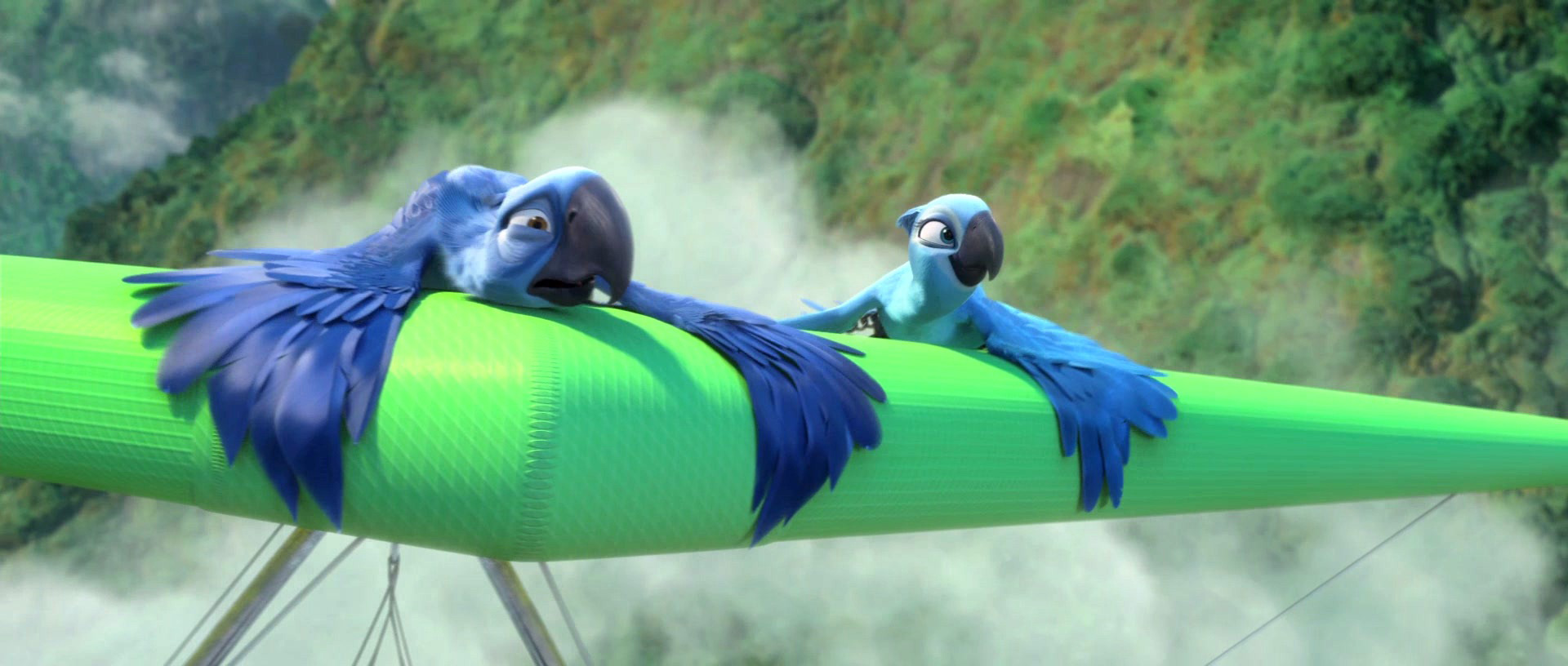
Given their advertising budget and worldwide marketing campaign, there's really not that much I need to say about the story, is there? Blu is voiced by Jesse Eisenberg, Jewel by Anne Hathaway. More here. The birds are supposed to be modeled after the critically endangered Spix's Macaw, already likely extinct in the wild. Here's what the real deal looks like:
Cocky Bennet, the world's longest lived parrot (that I know of).
"...a sulphur-crested cockatoo (Cacatua galerita), he stood out not
by the age he would reach, but for its unusual physical features. Born
in 1796 (according to Brisbane’s weekly summary, The Queenslander), near
Sydney, he was removed from his nest on a eucalypt by a local farmer.
As the years passed, he started to lose the feathers, looking like a
plucked chicken with a wrinkled skin. Moreover, his upper mandible had
an extraordinary long tip, so that he could only eat mashed food.
The bird spent his first 78 years travelling the world with Captain
Ellis, his owner. Following the death of the captain, he was bequeathed
to a Mr. and Mrs. Bowden. With the death of Mr. Bownden in 1889, his
wife soon married Charles Bennet, with the couple then moving to Tom
Ugly’s Point, Blakehurst, in 1891, where Mr. Bennet became the licensee
of the Sea Breeze Hotel.
Popular, Cocky lived in the hotel for most of his last 25 years.
Talkative, his repertory included phrases like “one feather more and
I’ll fly” and “one at a time, gentlemen, please”, when harassed by other
birds. Cocky was more talkative and with more lurid language after
being given a ”sip of strong brew”. He received the visitors while
moving and jumbling at the top of his cage in the hotel’s front
verandah."
After his death, The Sydney Morning Herald published (in 1916) the following note: A Venerable Cockatoo “Cocky Bennet,” a sulphur-crested Australian cockatoo, died on Friday in his 120th year
at Canterbury. This age is a record in longevity for an Australian
parrot so far as the officials records are concerned. For many years
this bird was in the possession of Mrs. Sarah Bennet, the licensee of
the Sea Breeze Hotel, at Tom Ugly’s Point. When she left there, about 12
months ago, she transferred the parrot to her nephew, Mr. Murdoch
Alexander Wagschall, at Woolpack Hotel, Canterbury. The old bird was
absolutely featherless for the last 20 years, but it maintained its
“patter” till the day before its death. “Cocky Bennet” was a great
traveller, and is said to have journeyed seven times round the world.
Mr. Wagschall has arranged to have remains of this historic parrot
preserved by a taxidermist.”
If you're really into parrots (especially transgenic African Greys), please be sure to check out my novel Little Birdies! It's available both as a softcover book and as a Kindle ebook. Excerpts from LittleBirdies! can be found here, and reviews here.
We've all seen and heard about Snowball, the dancing medium sulphur-crested cockatoo. Subsequent research has demonstrated that Snowball actually seems to be dancing, to be responding to different rhythms and timing, not just imitating the humans around him. Which is good, because he wouldn't be nearly as entertaining if he was stuck imitating these folks. I'm sure that everyone's just having a good time, but it's still mildly disturbing. I've always felt that people who can't dance, shouldn't. It just seems better for everyone that way...
The video is a little washed out, but it's otherwise a nice, concise look at the sort of work Dr. Irene Pepperberg was doing with the late Alex. The African Greys in Little Birdies! are involved with a similar vein of research before ... stuff happens.
Oh, I heard from the publisher earlier today; my "proof" copy of Little Birdies! is on the way.
Here's a great look at what is, in effect, the scientific basis for Little Birdies! It shows Dr. Irene Pepperberg discussing her work with Alex and Griffin, as well as a generally fun look at African Greys doing their thing...